
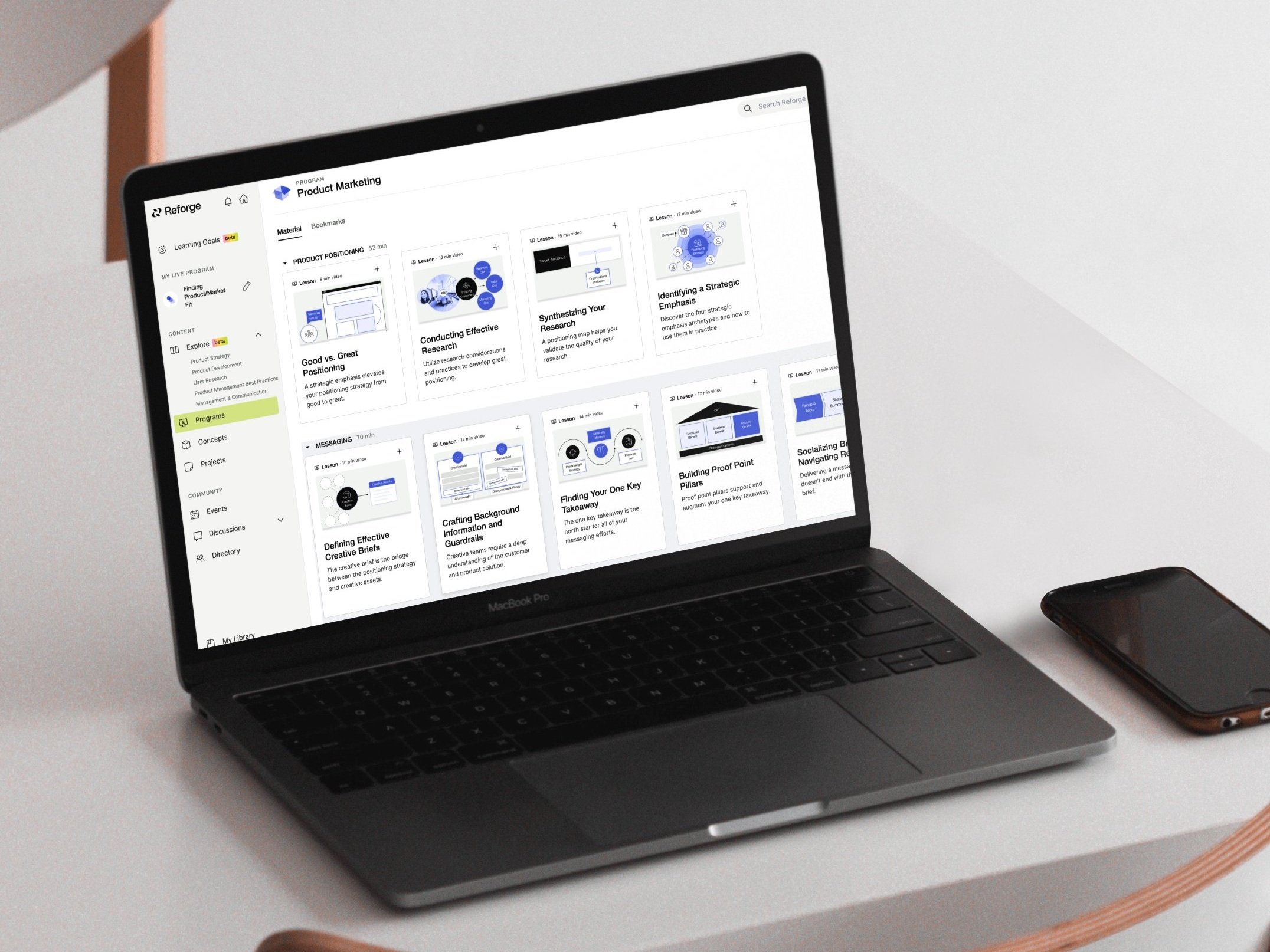
Product Management Course Creation
Reforge had a scaling problem. The Founder had been the sole creator of all program content — a bottleneck that couldn't hold as the company grew. The challenge: build a first-ever content creation team that could take ownership of program production without losing the quality and insight density that made Reforge's material worth paying for.
O V E R V I E W
Role
As a founding member of Reforge's inaugural course creation team, I helped build the content process that scaled across all future programs — combining structural editing, visual design, and close collaboration with Strategy Leads and SMEs to make complex material educationally sound.
Objectives
Build a scalable content creation process future teams could adopt without starting from scratch.
Make expert-level knowledge immediately actionable for busy mid-career tech professionals.


Business Outcomes & Impact
~$12.8M Revenue
2.2X Growth
Process Adopted by 100% of creation pods
10,000+ Clarifying Visuals
“I got promoted to Senior Product Manager and then most recently, got promoted to Line Product Manager and I attribute a lot of it to my studies at Reforge, so thanks for that!”— User Interview Summer ‘22
The creation process built here scaled unchanged to all subsequent Contentl Designers. I personally developed 40% of Reforge's program portfolio — directing and mentoring junior designers on 25% of that work.
D E S I G N P R I N C I P L E S
These principles weren't just personal guidelines — they became the foundation of Reforge's course creation approach. Through onboarding conversations, timeline negotiations, and iterative collaboration, they were absorbed into how the broader team worked, scaling consistently across all subsequent programs.
Intuitive Visuals
The visuals weren’t just nice to have. These were serious learning aids that facilitated understanding. They had to be intuitive enough so that learners could easily explain them to colleagues for buy-in.
Learner-Centered
The images and language in the visuals and narrative needed to reflect situations that were familiar to users.
Program Visual Commit
The program overview visual had to do more than list modules — the way they were arranged and connected needed to reflect the actual logic of the course. This was a thinking tool as much as a deliverable.
P R O C E S S
Getting up to speed on the user problem before creation
To get started on visual ideas for the program, I’d read up on available “Discovery Documents” to understand the problems our users faced and the boundaries set on the program content, joining some calls that the Strategy Leads (SLs) conducted with our subject-matter-experts (SMEs).
Defining Program Vision
We found that a key step was Content Designers pressure testing the organization of content through low-fidelity. Through this step, gaps in narrative would be identified, setting the program in the optimal direction.

One of many iterations of the program’s possible throughline
Co-creating the narrative
As Content Designers go into the nitty gritty of each module’s lesson content, they come up with metaphors or scenarios that would inform the narrative. This step pushed strategists to clarify their thoughts.
Learner responses to programs I contributed to.

Early sketch for a module’s content
Getting the final product to be one cohesive, frictionless, body of information
Finally, Content Designers start designing the lesson visuals in full, working off of early images. Continuing a collaborative push-pull with the Strategists— they flag where visuals don't land or flow feels off, while Designers push back on narrative gaps that visuals can't bridge alone.
This push-pull between image and story results in the module coming together in one coherent learning experience!

These images (and many more) coming together in one cohesive module!
Complex Ideas Made Clear


